Krka National Park
Krka National Park
Just 15 km from Šibenik, Krka National Park strings together waterfalls, lakes, island monasteries and Roman remains across 109 km² shaped by the Krka river.
Krka National Park sprawls across 109 km² in the hinterland of Šibenik, in central Dalmatia. Shaped by the Krka river, it chains together tiered waterfalls, lakes, island monasteries and Roman remains. It ranks as Croatie's second most-visited park, behind Plitvice Lakes.
Why visit Krka National Park
Krka concentrates, within a manageable area, natural landscapes carved by water and a wealth of historical heritage. The waterfalls of Skradinski Buk and Roški Slap are traversed via wooden boardwalks, accessible to all fitness levels. Archaeology enthusiasts will find the remains of the Roman aqueduct of Scardona and the amphitheater of the Burnum military camp. Those passionate about religious history can reach by boat the Franciscan monastery of Visovac, perched on an islet in Lake Visovačko Jezero. The park's diversity allows you to spend half a day or a full day there.
A brief history
The Krka valley has been inhabited since prehistoric times: paleolithic objects and neolithic ceramics have been unearthed within the park's boundaries. In Roman times, the area hosted the aqueduct of Scardona, whose remains still stand, as well as the military camp of Burnum.
The industrial era also left its mark: in 1895, Croatie's first hydroelectric dam operating on alternating current was installed on the Krka, among the very first in Europe. The area was designated a national park in 1985 to preserve its karstic ecosystem and built heritage.
What to see at Krka National Park
Skradinski Buk waterfall
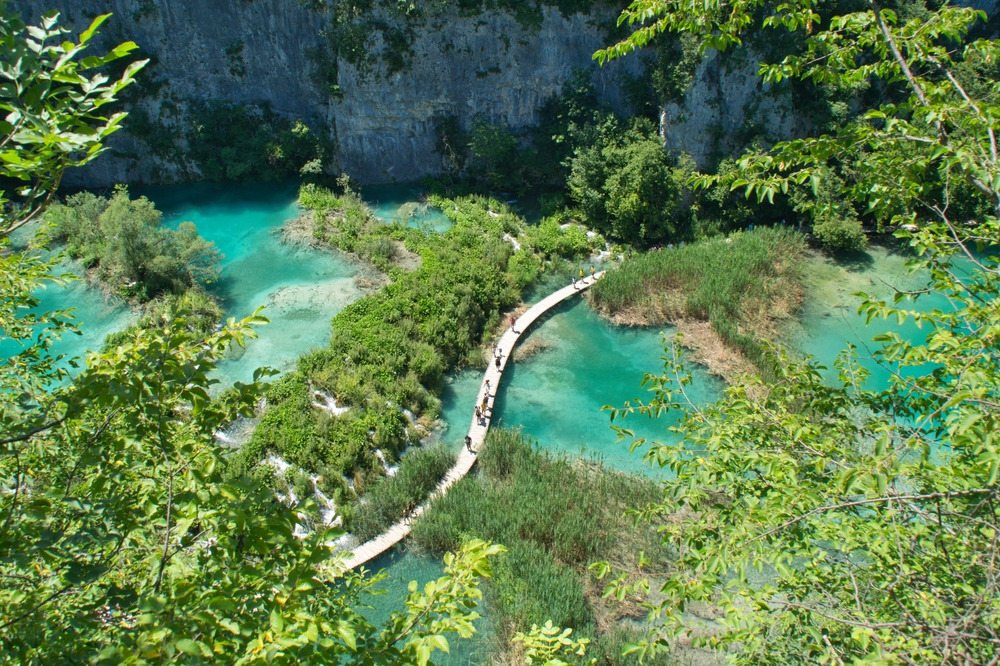
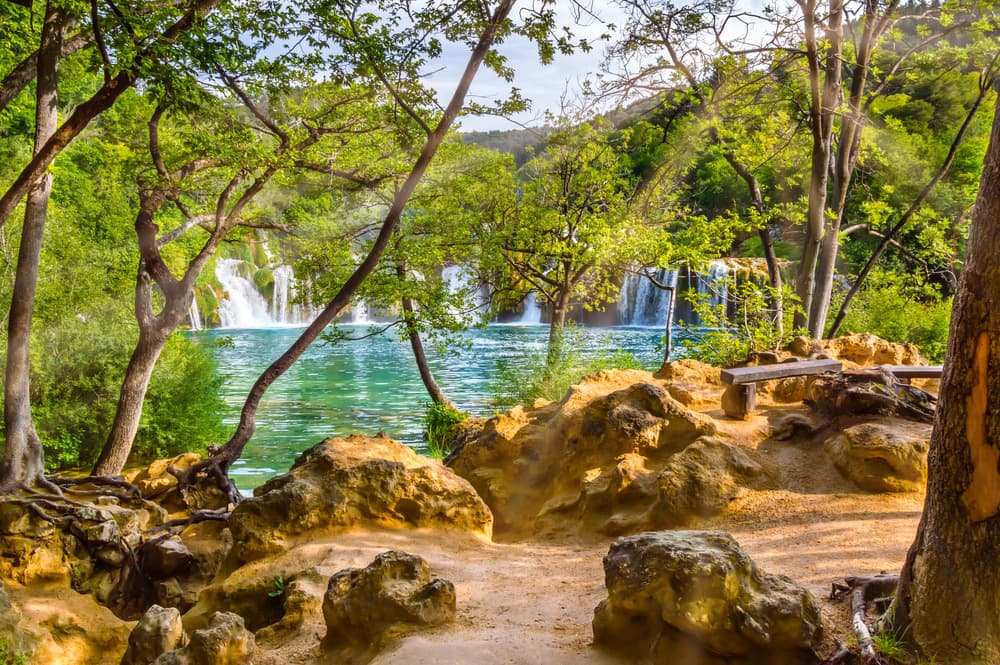
Skradinski Buk is the most visited site in the park. Born from the confluence of the Krka and Čikola rivers, this waterfall stretches across 800 meters and comprises 17 successive drops, totaling a height of 46 meters. A wooden boardwalk circles the pools and allows you to walk along the tufa terraces at water level, amid lush vegetation teeming with dragonflies and water birds.
Manojlovački waterfall
Manojlovački is the park's highest waterfall, with a total elevation drop of 60 meters and a main drop of 32 meters, set within a canyon. Flow depends heavily on rainfall: in a dry summer, the water level can be greatly reduced or even cease entirely. It's best to check conditions before visiting. A viewing platform overlooks the canyon.
Lake Visovačko Jezero and Visovac Monastery
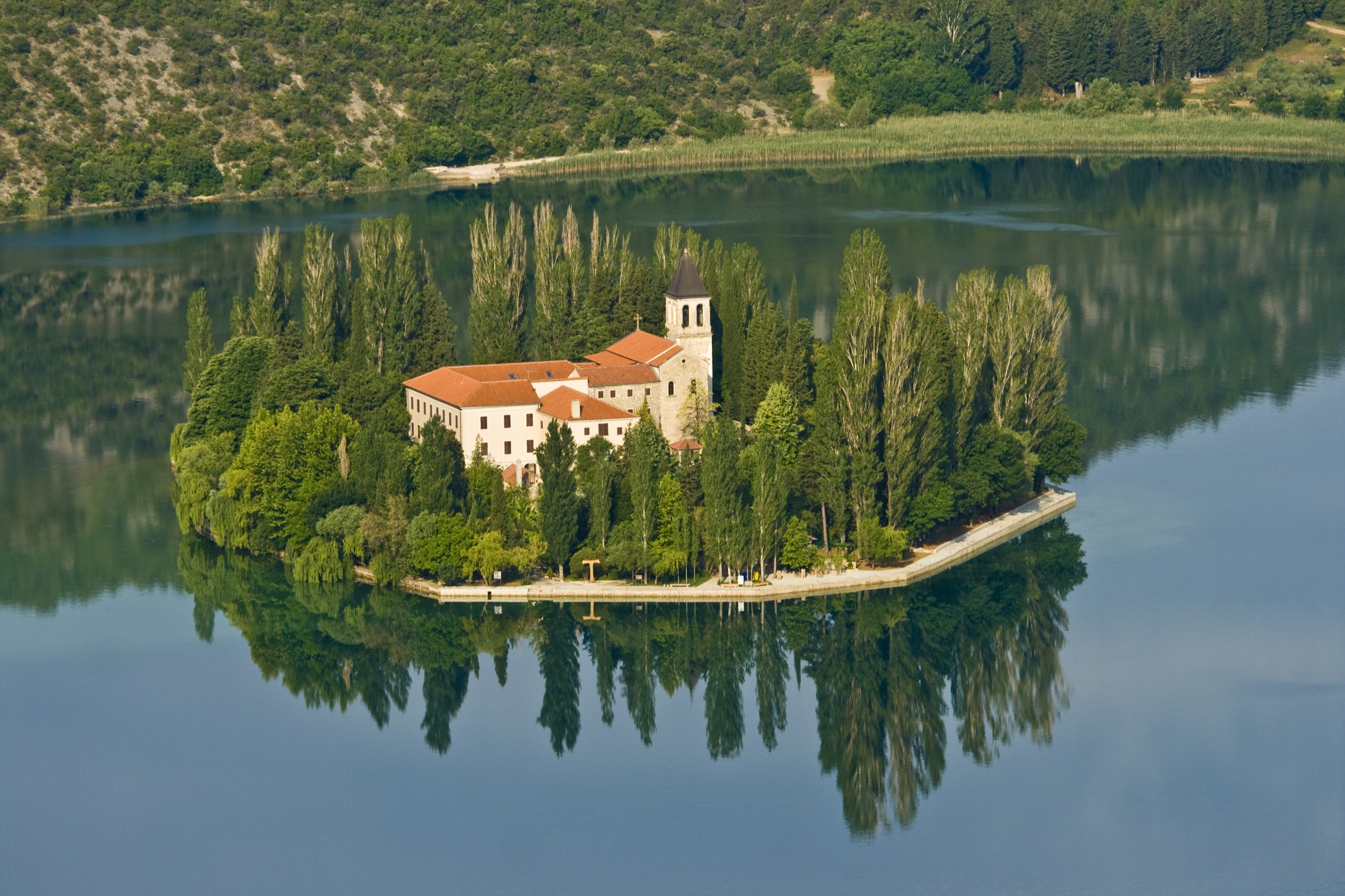
In the heart of the park, the Krka widens to form Visovačko Jezero lake. In its center, an islet hosts the Franciscan Monastery of Visovac, founded in the 15th century. The ensemble comprises white-arcaded buildings, a cloister and gardens. The monastery museum houses paintings from the 16th and 17th centuries, sacred art objects and liturgical vestments.
Access is by boat from the landing points at Stinice or Remetić: the crossing takes approximately 5 minutes and a visit on site around 30 minutes.
Roški Slap waterfalls
Upstream from Lake Visovačko, Roški Slap lines up twelve falls formed on tufa barriers spanning 650 meters long and 450 meters wide. Along the banks stand old stone mills, testament to the river's agricultural use. Access is by car or boat from Skradinski Buk.
Burnum Amphitheater
The Roman military camp of Burnum preserves the ruins of an amphitheater that could accommodate 8,000 spectators. The site, still under excavation, completes the visit for archaeology enthusiasts.
Krka Monastery
Away from the main crowds, the Orthodox Monastery of Krka, founded in 1345, occupies a secluded site above the river. It can be visited from the park entrance that bears its name.
Practical information
The five park entrances
- Lozovac: main entrance, large parking, seasonal shuttles to Skradinski Buk.
- Skradin: access to Skradinski Buk by boat or via hiking trail of around 3 km along the river. Limited parking in the village.
- Roški Slap: direct access to the waterfalls of the same name, limited parking.
- Burnum: dedicated entrance to the Roman remains.
- Krka Monastery: access to the Orthodox monastery, by car or boat.
Rates and hours
The park applies seasonal pricing: budget-friendly entry in low season (winter and shoulder season), significantly higher in peak season (June to September), with shuttle and boat inclusion varying by period. Hours also vary: early morning opening, late afternoon closing in winter and early evening in summer. Check current conditions on the official website before your visit, as some services (shuttles, internal boats) only operate during the good season.
Swimming has been prohibited since 2021 within the park grounds for ecological reasons. It remains permitted in the lower stretch of the river, near the village of Skradin.
When to visit
From late April to June, waterfall flow is still strong after snowmelt and spring rains, while visitor numbers remain reasonable. July and August offer the most stable conditions for boats and shuttles, but crowds are heavy and some secondary waterfalls like Manojlovački may run dry. September and early October strike a good balance: mild temperatures, favorable light, crowds thinned out. In winter, snow-covered or misty landscapes have their charm, but several services are closed and access to internal sites is limited.
How to get there
A car remains the most flexible way to connect the park's various points, particularly distant sites like Manojlovački or Burnum. The Lozovac entrance, roughly fifteen kilometers from Šibenik, serves as the classic starting point.
Without a vehicle, several options exist:
- From Šibenik, local buses serve Lozovac and Skradin.
- From Split or Trogir, organized day excursions include transport and entry.
- By public transit: a bus to Skradin, then a park boat in season to Skradinski Buk.
Nearby
The park pairs well with a stop in Šibenik, whose Saint James Cathedral is a UNESCO World Heritage site, and with the coastal cities of Trogir and Split. Moving up toward the Istrian Peninsula, the Euphrasian Basilica of Poreč continues the thread of paleochristian and Byzantine heritage. Art and religious history enthusiasts can add Zagreb Cathedral, and those continuing southward with the wooded island of Lokrum, facing Dubrovnik.
FAQ
Frequently asked questions
No. Since 2021, swimming is prohibited within the park for ecological preservation reasons. It remains possible in the lower stretch of the river, near the village of Skradin, outside the protected perimeter.
Plitvice, with its 16 tiered lakes and 8 marked trails, suits hikers seeking a large forest park. Krka is more compact, more accessible from the Dalmatian coast, and combines waterfalls, monasteries and archaeological sites. If you're staying near Split or Šibenik, Krka is the logical choice.
Allow 2 to 3 hours for Skradinski Buk alone, and a full day to combine waterfalls, Visovac Monastery and Roman sites. The distance between internal sites warrants a vehicle or park boats.
Skradinski Buk and Roški Slap maintain flow throughout the year. However, Manojlovački can be greatly reduced or even run dry during the height of summer following a dry season. Spring and autumn offer the most spectacular conditions.
Plan your trip
Krka National Park integrates easily into a Dalmatian itinerary, between Split and Zadar, or as a day excursion from Šibenik. For a custom-made trip including waterfalls, islands and historic towns, explore our travel ideas in Croatie.
Nearby
Interested in this visit?
We can include it in your personalised itinerary.